

You cleared your schedule. You meal-prepped on Sunday. You were doing so well. Then Tuesday hit, you walked into your kitchen, glanced at the pile of mail, the mismatched Tupperware lids, the half-finished coffee mug from this morning, and suddenly you needed a handful of crackers you didn’t even want. Sound familiar? That’s the Clutter–Cortisol Connection at work, and it’s quietly running your eating habits in the background like an app you never opened.
This isn’t about willpower. It’s about your brain’s stress response, and once you understand how it works, you’ll never look at your kitchen counter the same way again.
What Your Kitchen Counter Is Actually Doing to Your Brain
Here’s what the research shows: a study published in Environment and Behavior found that women in cluttered homes had significantly higher levels of cortisol, the body’s primary stress hormone, throughout the day compared to women in tidy homes. Not just in the morning. All. Day. Long.
Cortisol isn’t inherently bad. It’s designed to help you survive a threat, spike fast, then drop off. The problem is that your brain can’t fully distinguish between a looming work deadline and a counter covered in last week’s grocery bags. Visual chaos reads as low-level danger. And when danger signals stay on, cortisol stays elevated.
That matters for your eating because elevated cortisol does two very specific things. It increases your appetite for calorie-dense foods, think sugar, salt, fat, and it simultaneously weakens the part of your brain responsible for making calm, intentional decisions. So you’re hungrier and less equipped to pause and think. That’s not a character flaw. That’s neuroscience.
The Clutter–Cortisol Connection: Why Your Environment Is a Hidden Trigger
Most stress-eating advice focuses on what’s happening inside you: your emotions, your thoughts, your habits. And that matters, it really does. But your environment is constantly feeding signals to your nervous system before you even have a conscious thought.
Think of your brain like a security system. It’s always scanning. Piles of unread mail? Scan. Dishes in the sink? Scan. Three different half-open bags of chips on the counter? Scan, scan, scan. Each one on its own might feel trivial. But stacked together across an entire day, in a kitchen, a living room, a car, a desk, they create a constant low hum of “something is wrong here.”
And when your nervous system stays in that low hum? Your body stays in stress mode. Your cravings don’t shut off. You eat past fullness and don’t know why. You promise yourself tomorrow will be different, and the cycle starts again.
This is especially true if you’re someone who holds everything together for everyone else. The woman managing her career, her household, her kids, her aging parents, and probably someone else’s emotional needs too. When you’re already running at capacity, your nervous system is already dialed up. The cluttered counter doesn’t create the stress, it compounds it.
Why Cleaning the Whole House Won't Fix It
Before you go into a Sunday spiral trying to reorganize every room, stop. That approach almost always backfires for two reasons.
First, tackling everything at once feels enormous, so you don’t start. Second, big overhaul projects create their own temporary chaos, which spikes the very cortisol response you’re trying to calm.
Instead, the research and practical experience both point to something much smaller and more powerful: the single-zone reset.
Pick one small, visible surface in your home. For most people, that’s the kitchen counter. It’s the first place you see when you walk in after a long day, and it’s the space you’re standing in when cravings tend to hit hardest.
Here’s the only rule: keep one defined zone completely clear. Not perfect. Not magazine-worthy. Just clear. Nothing on that surface that doesn’t belong there right now.
That’s it.
It sounds almost too simple, and I suspect that’s why most people skip it. But what you’re actually doing is sending a very deliberate signal to your nervous system: this space is calm, this space is safe. That signal interrupts the cortisol feedback loop before it reaches your pantry.
The Snack Trigger You've Been Completely Ignoring
Let’s talk about the specific moment this plays out. You’ve probably noticed it without naming it.
You come home, you’re tired, the kitchen looks chaotic. You don’t even feel hungry exactly, but you find yourself opening a cabinet anyway. Or you’re working from home, you glance up from your screen, and your eye lands on the pile of stuff on the counter. Fifteen minutes later you’re eating something you didn’t plan to eat.
That’s not a food problem. That’s a stress response that found the fastest available relief.
Your brain has learned, over years probably, that eating provides a short-term drop in tension. It works. That’s why the habit stuck. Comfort foods trigger a small dopamine release, briefly lowering the feeling of threat. Your brain isn’t broken for making that connection. It’s doing exactly what it was trained to do.
So when the visual stress signal hits and cortisol rises, your brain is already scanning for its fastest option to bring that feeling down. And if there are snacks visible on the counter? You already know how that ends.
Removing the visual clutter removes one trigger. Removing the visible food removes another. Together, they quietly disrupt the pattern before it starts.
A Simple Reset That Takes Less Than Four Minutes
You don’t need a cleaning routine. You don’t need a label maker or a perfectly organized pantry. You need a reset ritual that’s short enough to actually do on a hard day.
Here’s what works:
Before you sit down after work (or before you start dinner, or before bed, pick one anchor moment), do a four-minute counter reset. Set a timer if it helps.
- Clear anything that doesn’t belong on that surface.
- Wipe it down quickly.
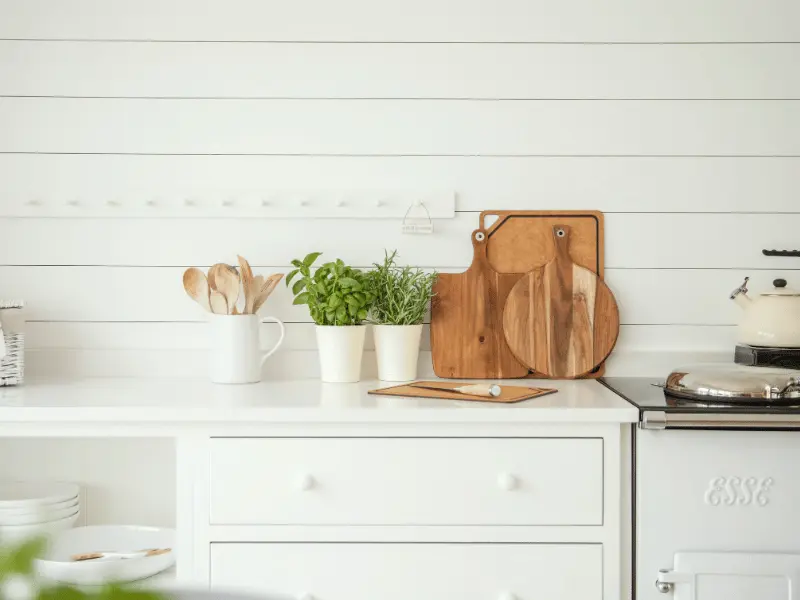
- Put one thing you love on it. A candle. A plant. A pretty mug. Something that feels calm.
That last step matters more than it sounds. You’re not just removing the chaos signal. You’re actively replacing it with a calm one. You’re essentially retraining what your brain associates with that space.
Over time, walking into that kitchen starts to feel different. Slightly quieter. A little more settled. And that slight shift in your baseline stress level can genuinely change what you reach for, or whether you reach for anything at all.
What This Means for Your Eating Habits Long-Term
Here’s the part that I find genuinely fascinating. The Clutter–Cortisol Connection isn’t just about one snacking moment. It’s about what happens to your food decisions across an entire day when your cortisol baseline is chronically elevated.
When you’re in a low-level stress state all day, every food decision becomes harder. Choosing the salad over the sandwich feels like more effort. Stopping at “enough” feels nearly impossible. Emotional eating feels automatic rather than intentional.
That’s not a discipline problem. That’s biology working against you.
So when you address the environmental stress signals, even small ones, you’re not just avoiding one handful of crackers. You’re lowering the baseline that every single food decision happens against. Your choices get a little easier. Not perfect, but easier. And easier, sustained over time, is what actually builds the kind of habits that stick.
Start With Just This
If you take nothing else from this, take this: your environment is part of your biology. The space around you is either adding to your stress load or subtracting from it. And your eating habits are responding to that signal whether you’re aware of it or not.
You don’t have to overhaul your home. You don’t have to be someone who loves cleaning or has a perfectly curated kitchen. You just have to pick one surface, keep it clear, and notice what changes.
Start tonight. Set a four-minute timer. Clear the counter. See how the kitchen feels tomorrow morning.
Small things, done consistently, are what actually change the patterns that feel impossible to break.
References
No place like home: home tours correlate with daily patterns of mood and cortisol, 2010. Darby E Saxbe, Rena Repetti
Stress and Eating Behaviors, 2014. Yvonne Yau, Marc Potenza
Eating behavior and stress: a pathway to obesity, 2014. Luba Sominsky, Sarah J Spencer
Food cue reactivity: Neurobiological and behavioral responses to food cues in obesity and binge-eating, 2022. Scott Kanoski, Kerri Boutelle
Stress signaling pathways that impair prefrontal cortex structure and function, 2009. Amy Arnsten